Start here · a little extra help
Weight often means thickness
In a yarn description, ‘weight’ can mean a thickness category, not how heavy the ball is. DK stands for double knitting, a commonly used yarn thickness name. A 100 g ball describes mass, while metres or yards describe how much length is inside.
Two balls with the same mass can contain very different lengths. When replacing a yarn, compare fibre, thickness and length as well as your gauge. A dye lot is a batch of yarn dyed together; matching lot numbers helps avoid unexpected shade changes.
Your small practice goal
Find the fibre, length, mass, hook suggestion, care instructions and dye-lot number on a yarn label.
Picture it
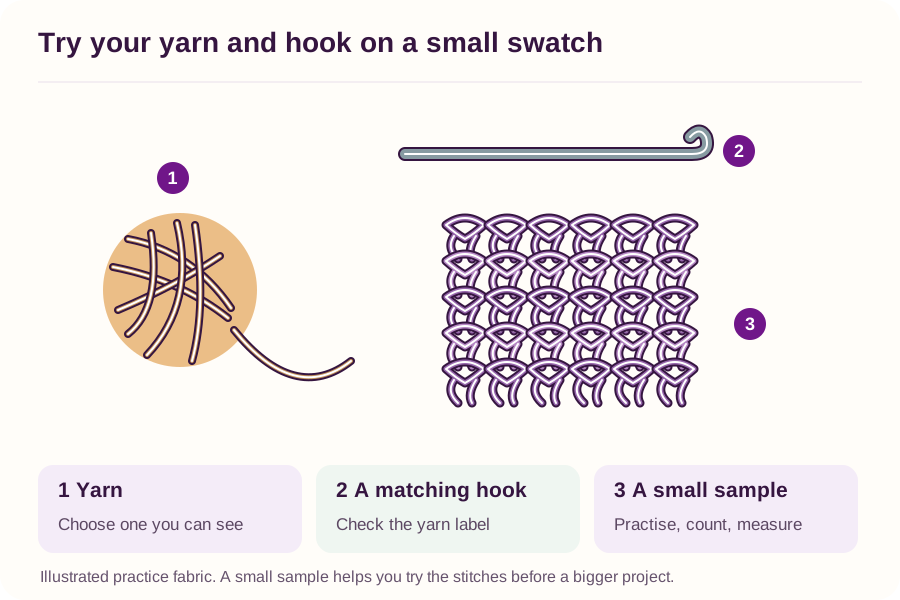
Select the diagram to open it at full size. Use the written steps for the actual hook movements.
Words you’ll meet
No need to memorise these. Keep them nearby and look up a word whenever you need it. This guide uses UK names, with US equivalents explained.
Open the plain-English word guide · 6 terms
UK dc / US sc
UK double crochet is called single crochet in US patterns. They are the same short stitch.
Swatch
A small sample used to practise or to check the fabric, stitch size and washing behaviour.
Gauge / tension
The number of stitches and rows in a measured area. Tension can also mean how firmly you hold the yarn.
DK · double knitting
A yarn thickness name. Despite the name, DK yarn can be used for crochet.
Aran
A yarn thickness name, generally thicker than DK. Check the label and your gauge rather than relying only on the name.
Dye lot
A batch of yarn dyed together. Different batches of the same named colour can vary slightly.
Quick note: this guide uses UK crochet names. UK double crochet is US single crochet.
A quick thickness guide
| CYC category | Common names you may see |
|---|---|
| 0 — Lace | Lace |
| 1 — Super fine | Fingering / sock |
| 2 — Fine | Sport |
| 3 — Light | DK |
| 4 — Medium | Worsted / aran |
| 5 — Bulky | Chunky |
| 6 — Super bulky | Super chunky |
| 7 — Jumbo | Jumbo |
Names and thicknesses vary between brands. These categories are guides, not promises that two yarns will behave identically.
Save the band
Look for fibre content, metres per ball, suggested hook, care instructions, colour number and dye lot. If two balls must match, compare their dye lots in daylight. Photograph the label before it disappears into the project bag.
Swap yarn with a plan
Compare length as well as grams: 100 g of one yarn can contain a very different length from 100 g of another. Swatch the replacement, wash it appropriately and check the fabric's feel and measurements. Buy for the required total length with a sensible allowance, not just the same number of balls.
Sources & further learning
Checked 24 October 2026. Written in UK terms, with US equivalents where useful. Follow a project's own stitch key if it differs. These are original explanations and practice exercises, not copies of the linked publishers' patterns.