Start here · a little extra help
The yarn label is your starting point
The correct care depends on the fibre and construction, not simply on the fact that something is crocheted. A blend may need more cautious care than you expect. Keep the yarn label and pass clear care information to the person who will use the finished piece.
Support wet fabric rather than lifting it by one corner, because its own weight can stretch it. Do not assume every item can be tumble dried, ironed or soaked. If several yarns are used, choose a method safe for all of them and any attached parts.
Your small practice goal
Write a small care card for a finished sample using its actual label. Include the fibre and any drying instructions.
Picture it
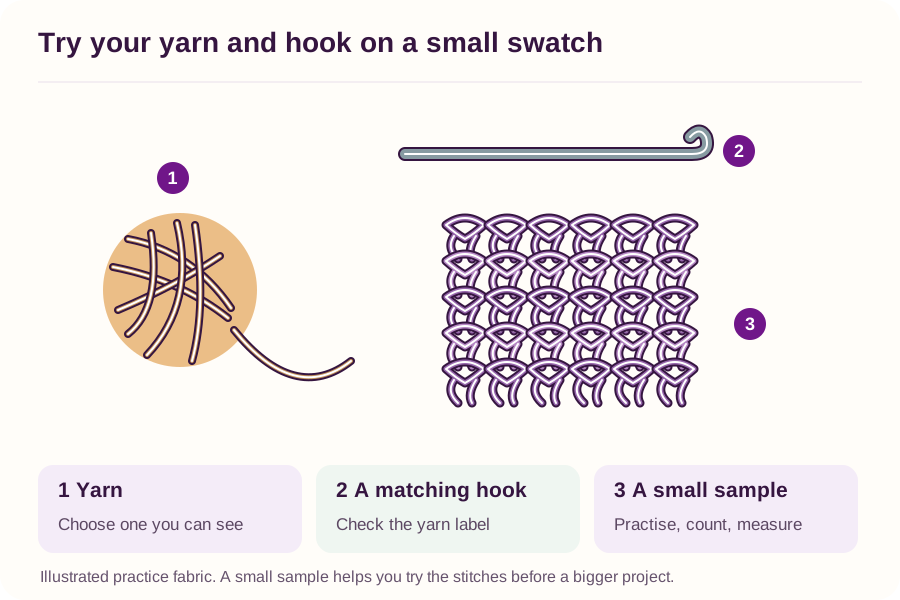
Select the diagram to open it at full size. Use the written steps for the actual hook movements.
Words you’ll meet
No need to memorise these. Keep them nearby and look up a word whenever you need it. This guide uses UK names, with US equivalents explained.
Open the plain-English word guide · 3 terms
UK dc / US sc
UK double crochet is called single crochet in US patterns. They are the same short stitch.
Swatch
A small sample used to practise or to check the fabric, stitch size and washing behaviour.
Dye lot
A batch of yarn dyed together. Different batches of the same named colour can vary slightly.
Quick note: this guide uses UK crochet names. UK double crochet is US single crochet.
The label beats a general rule
‘Handmade’ does not tell you whether something can go in a washing machine. Fibre, dye, construction and decorations all matter. Follow the yarn manufacturer's instructions and the pattern's care advice. With mixed yarns, choose a method compatible with every component.
Make a care card
- Record the yarn brand, fibre, colour and dye lot while you still have the band.
- Write the permitted washing and drying method in plain language. Test a swatch if you are unsure how colours or size will behave.
- Give that note with a gift, along with a little spare yarn for future repairs.
Store it kindly
Put away only when fully dry. Fold items that could stretch on a hanger and keep them clean and protected from snags. If a strand catches, do not cut it off in a panic: gently work the slack back through nearby stitches. A small repair is much easier before the damage spreads.
Sources & further learning
Original Crochet By Micky practice notes. See the linked lessons for the underlying techniques.
Checked 24 October 2026. Written in UK terms, with US equivalents where useful. Follow a project's own stitch key if it differs. These are original explanations and practice exercises, not copies of the linked publishers' patterns.