Start here · a little extra help
Measure fabric, not effort
Gauge tells you how many stitches and rows fit into a measured area. Two people using identical yarn and hooks can make different-sized fabric because they hold and pull the yarn differently. This is normal; a gauge swatch tells you what your own fabric does.
Make a sample larger than the area you need to measure. Treat it as you will treat the finished item, following the yarn care label, then lay it flat without stretching. Count stitches across the middle and rows up the middle. Avoid the wobbly edges.
Your small practice goal
If 16 stitches fill 10 cm, a 32-stitch-wide piece will be about 20 cm wide in that same fabric. Measure row height separately.
Picture it
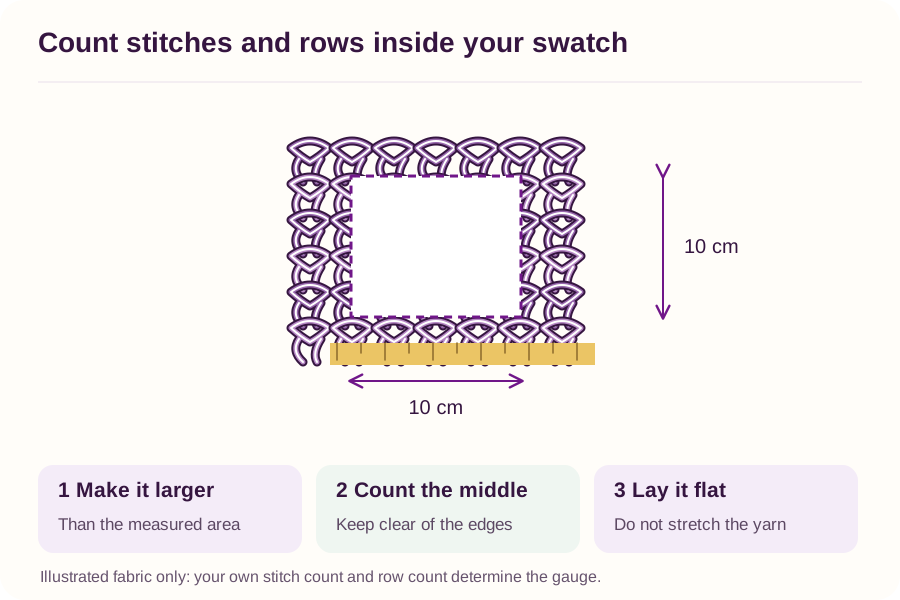
Select the diagram to open it at full size. Use the written steps for the actual hook movements.
Words you’ll meet
No need to memorise these. Keep them nearby and look up a word whenever you need it. This guide uses UK names, with US equivalents explained.
Open the plain-English word guide · 5 terms
UK dc / US sc
UK double crochet is called single crochet in US patterns. They are the same short stitch.
Swatch
A small sample used to practise or to check the fabric, stitch size and washing behaviour.
Gauge / tension
The number of stitches and rows in a measured area. Tension can also mean how firmly you hold the yarn.
cm · centimetres
A unit of length used to measure fabric and finished projects. One centimetre is ten millimetres.
Repeat · rep
Do the stated group of instructions again, as many times as the pattern says.
Quick note: this guide uses UK crochet names. UK double crochet is US single crochet.
Measure your own fabric
Gauge means stitches and rows over a measured distance. Make a swatch larger than the area you will measure, using the project's stitch pattern. Wash or block as the yarn and pattern allow, let it dry fully, then measure the middle without stretching it.
Use the numbers
Example: your 10 cm width contains 20 stitches, so each centimetre uses about 2 stitches. A plain 24 cm panel would need about 48 stitches. A stitch repeat, seam allowance or border may change that number. Row gauge matters for height too.
Adjust and try again
| Compared with the pattern | Try |
|---|---|
| Too many stitches in 10 cm | A larger hook, then another swatch |
| Too few stitches in 10 cm | A smaller hook, then another swatch |
| Width matches, height does not | Check stitch technique and row gauge; do not guess garment shaping |
Hook sizes are starting points, not a scorecard. Keep a note of the yarn, hook and washed measurements with your project.
Sources & further learning
Checked 24 October 2026. Written in UK terms, with US equivalents where useful. Follow a project's own stitch key if it differs. These are original explanations and practice exercises, not copies of the linked publishers' patterns.