Start here · a little extra help
Choose what happens to the spare yarn
In tapestry crochet, you often carry the unused colour along inside the stitches you are making. Intarsia uses separate small supplies of yarn for separate colour areas. A bobbin is a small holder for one of those supplies, not a special kind of stitch.
Carrying yarn can make thicker fabric and may allow the spare colour to show through. Separate bobbins reduce carrying but create more tails and need careful joins at colour boundaries. A float is an unused strand travelling behind the work; long loose floats can snag.
Your small practice goal
Make two small colour blocks. Compare a carried-yarn sample with a separate-bobbin sample before choosing a method for a big chart.
Picture it
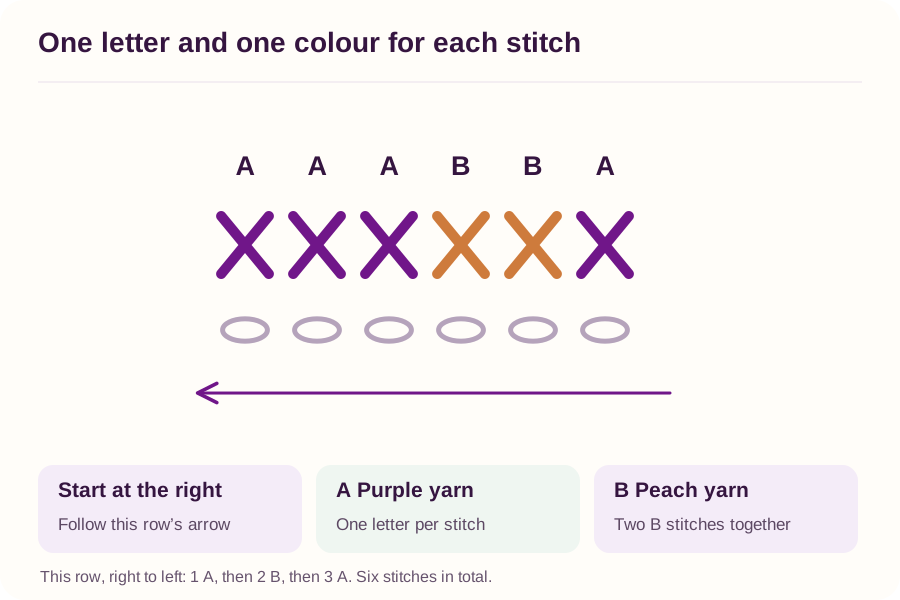
Select the diagram to open it at full size. Use the written steps for the actual hook movements.
Words you’ll meet
No need to memorise these. Keep them nearby and look up a word whenever you need it. This guide uses UK names, with US equivalents explained.
Open the plain-English word guide · 8 terms
UK dc / US sc
UK double crochet is called single crochet in US patterns. They are the same short stitch.
Yarn tail
A loose end left at the start, finish or colour change. It needs to be secured inside the fabric.
Gauge / tension
The number of stitches and rows in a measured area. Tension can also mean how firmly you hold the yarn.
Round · rnd
A complete trip around a shape. It may be joined at the end or continue in a spiral.
Motif
A separate repeatable piece, such as a square or flower, which may be joined to other pieces.
Bobbin
A small supply or holder of yarn for one colour area, useful when several colours are in use.
Float
An unused strand carried behind the fabric between places where its colour is needed.
Repeat · rep
Do the stated group of instructions again, as many times as the pattern says.
Quick note: this guide uses UK crochet names. UK double crochet is US single crochet.
Small repeats or big blocks?
| Method | Where the spare yarn goes | Try it for |
|---|---|---|
| Tapestry | Usually carried inside the stitches | Frequent small motifs |
| Intarsia | Separate balls or bobbins for colour areas | Larger separate colour blocks |
| Stranded colourwork | Carried behind the fabric as floats | A pattern designed for that construction |
Sample before the big picture
Make a two-colour strip with the actual yarn. In tapestry, lay the unused strand along the top of the previous row and crochet around it without pulling it tight. In intarsia, leave each ball with its colour area and pick it up again on the return row. Change colour on the last pull-through of the previous stitch.
Watch the fabric, not just the chart
If the strip puckers, your carried yarn may be too tight. If the spare colour shines through, adjust your colours or technique rather than simply yanking harder. Crochet stitches are not perfect square pixels, so a gauge sample helps you judge a picture's proportions.
Sources & further learning
Checked 24 October 2026. Written in UK terms, with US equivalents where useful. Follow a project's own stitch key if it differs. These are original explanations and practice exercises, not copies of the linked publishers' patterns.