Start here · a little extra help
Change the final pull-through
For many basic crochet stitches, a tidy colour change happens on the last pull-through of the previous stitch. Begin that stitch with the old colour, then use the new colour for its final yarn over. The live loop is now the colour needed for the next stitch.
Leave enough of both tails to weave in securely. Do not make the change so tight that the fabric puckers. If you carry an unused colour, check how it shows through and whether the strand can move freely enough for the fabric to lie flat.
Your small practice goal
Try two short blocks of colour on a small sample. Look at the tops of the stitches and see where the new colour starts.
Picture it
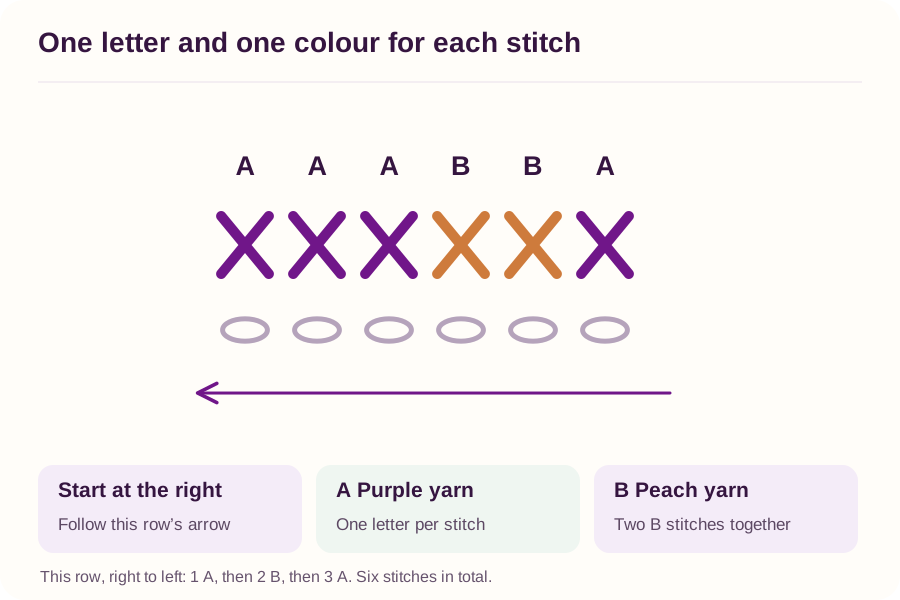
Select the diagram to open it at full size. Use the written steps for the actual hook movements.
Words you’ll meet
No need to memorise these. Keep them nearby and look up a word whenever you need it. This guide uses UK names, with US equivalents explained.
Open the plain-English word guide · 4 terms
UK dc / US sc
UK double crochet is called single crochet in US patterns. They are the same short stitch.
Yarn over · yo / yoh
Bring the working yarn over the hook so you can catch it and pull it through a loop.
Yarn tail
A loose end left at the start, finish or colour change. It needs to be secured inside the fabric.
Bobbin
A small supply or holder of yarn for one colour area, useful when several colours are in use.
Quick note: this guide uses UK crochet names. UK double crochet is US single crochet.
The last loop belongs to the next colour
For a neat UK-dc colour change, start the last stitch of colour A normally: insert, yarn over and pull up a loop. With two loops on the hook, use colour B for the final yarn over and pull through. The next full stitch is then worked in B. Leave tails long enough to weave in.
Try a tiny two-colour flag
Make a practice row of 10 dc. On the next row, work 5 stitches in A and 5 in B, changing on the final pull-through of stitch five. On the return row the colours appear in the opposite working order. Keep each colour in its own small ball and avoid tugging at the join.
Make a deliberate choice
For big blocks, separate bobbins can stop you carrying yarn across an entire row. For frequent small changes, carrying the unused yarn may be useful. Try a sample first: colour can show through, and carrying yarn changes the thickness of the fabric.
Sources & further learning
Original Crochet By Micky practice notes. See the linked lessons for the underlying techniques.
Checked 24 October 2026. Written in UK terms, with US equivalents where useful. Follow a project's own stitch key if it differs. These are original explanations and practice exercises, not copies of the linked publishers' patterns.