Start here · a little extra help
Fit is more than one measurement
Ease is the difference between your body measurement and the finished garment measurement. Positive ease gives extra room; negative ease means the garment is smaller and relies on stretch. A schematic is a simple drawing labelled with the finished measurements.
Use the pattern’s size chart and compare several measurements with a garment that fits as you want. The same stitch count can produce a different size if your gauge changes. Wash the swatch as the finished garment will be washed and measure it again before committing to the full project.
Your small practice goal
Make a project sheet with your chosen size, required gauge, actual gauge and finished width and length.
Picture it
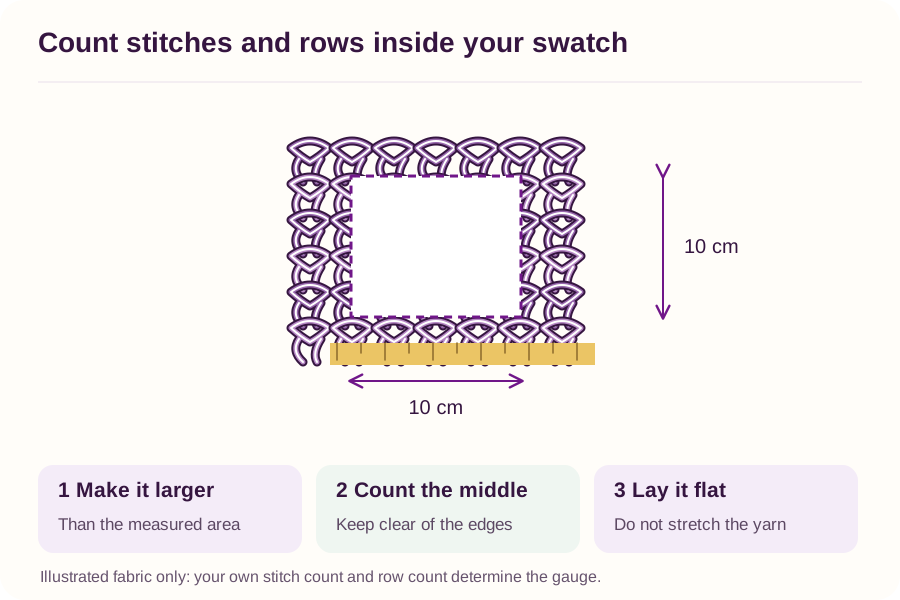
Select the diagram to open it at full size. Use the written steps for the actual hook movements.
Words you’ll meet
No need to memorise these. Keep them nearby and look up a word whenever you need it. This guide uses UK names, with US equivalents explained.
Open the plain-English word guide · 6 terms
UK dc / US sc
UK double crochet is called single crochet in US patterns. They are the same short stitch.
Swatch
A small sample used to practise or to check the fabric, stitch size and washing behaviour.
Gauge / tension
The number of stitches and rows in a measured area. Tension can also mean how firmly you hold the yarn.
Dye lot
A batch of yarn dyed together. Different batches of the same named colour can vary slightly.
Schematic
A simple outline drawing marked with a project’s finished measurements.
Ease
The difference between body and garment measurements: extra room or, with stretch, a closer fit.
Quick note: this guide uses UK crochet names. UK double crochet is US single crochet.
Start with a pattern, not a guess
Choose a clearly written garment pattern with a size chart, finished measurements and a schematic. Compare those finished measurements with a garment you already like wearing. The difference between body size and garment size is ease; the amount depends on the intended fit.
Your project checklist
- Mark your chosen size throughout the pattern. Check all the measurements, not just the chest.
- Make and appropriately wash a gauge swatch in the actual stitch pattern. Test how it drapes and feels.
- Record yarn length needed and buy a suitable allowance. Keep the dye-lot labels.
- Note construction order, shaping points and where the pattern allows fitting checks. Count and measure as you go.
Changing size is not just changing hooks
A bigger hook changes fabric as well as dimensions. Simply adding stitches can move armholes, necklines and shaping out of place. For a first wearable, follow a tested size and its gauge; save ambitious redesigns for when you understand how the pieces fit together.
Sources & further learning
Original Crochet By Micky practice notes. See the linked lessons for the underlying techniques.
Checked 24 October 2026. Written in UK terms, with US equivalents where useful. Follow a project's own stitch key if it differs. These are original explanations and practice exercises, not copies of the linked publishers' patterns.