Start here · a little extra help
The method belongs to you
Your hook hand decides the usual direction of an ordinary row. A left-handed maker commonly works left to right, while a right-handed maker commonly works right to left. Turning the work lets each maker travel back along the next row comfortably.
A mirrored demonstration can help with hand movements, but mirrored writing or a picture chart can become backwards. Follow the chart’s direction notes for lettering and other asymmetric images. Counting stitches and checking the pattern’s turning-chain rule are useful whichever hand holds the hook.
Your small practice goal
Make a short sample with a marker at each edge. Use a left-handed demonstration and pause after each movement.
Picture it
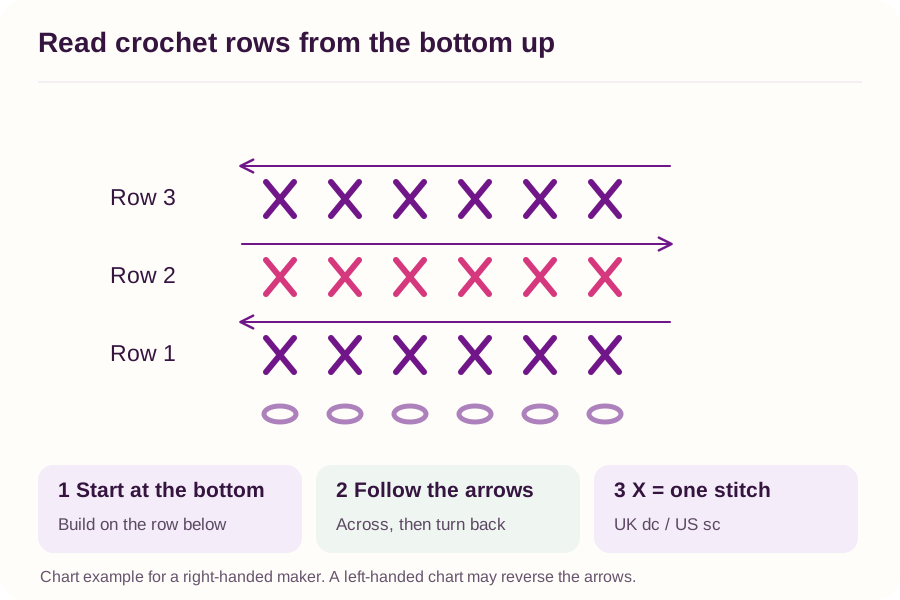
Select the diagram to open it at full size. Use the written steps for the actual hook movements.
Words you’ll meet
No need to memorise these. Keep them nearby and look up a word whenever you need it. This guide uses UK names, with US equivalents explained.
Open the plain-English word guide · 6 terms
Chain · ch
A small loop pulled through the loop on your hook. A line of chains often forms the starting edge.
UK dc / US sc
UK double crochet is called single crochet in US patterns. They are the same short stitch.
Yarn over · yo / yoh
Bring the working yarn over the hook so you can catch it and pull it through a loop.
Swatch
A small sample used to practise or to check the fabric, stitch size and washing behaviour.
Gauge / tension
The number of stitches and rows in a measured area. Tension can also mean how firmly you hold the yarn.
Repeat · rep
Do the stated group of instructions again, as many times as the pattern says.
Quick note: this guide uses UK crochet names. UK double crochet is US single crochet.
Start with the same building blocks
The stitch recipe stays the same: yarn over, insert, pull through. With a hook in the left hand, ordinary rows usually travel left to right instead of right to left. A left-handed demonstration can make the movement much easier to follow than mentally flipping every step.
Practise before reading a picture
- Make a short chain and a small UK-dc swatch. Mark both edge stitches and count after each row.
- Use a tutorial that explicitly offers a left-handed view. Check written labels separately if a video is mirrored.
- For a chart with lettering or an asymmetric picture, read its handedness and row-direction notes. Do not assume reversing every row will preserve the image.
Ask a useful question
If a right-handed maker is helping, sitting opposite them can make the action easier to mirror. Tell them which stitch and step is confusing. There is no prize for doing it in the most awkward way; a comfortable method you can repeat is the goal.
Sources & further learning
Checked 24 October 2026. Written in UK terms, with US equivalents where useful. Follow a project's own stitch key if it differs. These are original explanations and practice exercises, not copies of the linked publishers' patterns.