Start here · a little extra help
Meet the two ends of the yarn
The working yarn is the long strand leading to the ball. The tail is the short loose end left after making your starting knot. You use the working yarn for new stitches; the tail stays free to be sewn in later. A bight simply means a bent section of yarn, not the cut end.
The live loop is the loop currently sitting on your hook. It is waiting to become the next stitch, so it is not part of your chain count. Keep that loop on the wider, straight shaft of the hook to avoid making it too tight.
Your small practice goal
Make ten chains. Point to each finished V with a fingertip and count aloud, leaving out the knot and the live loop.
Picture it
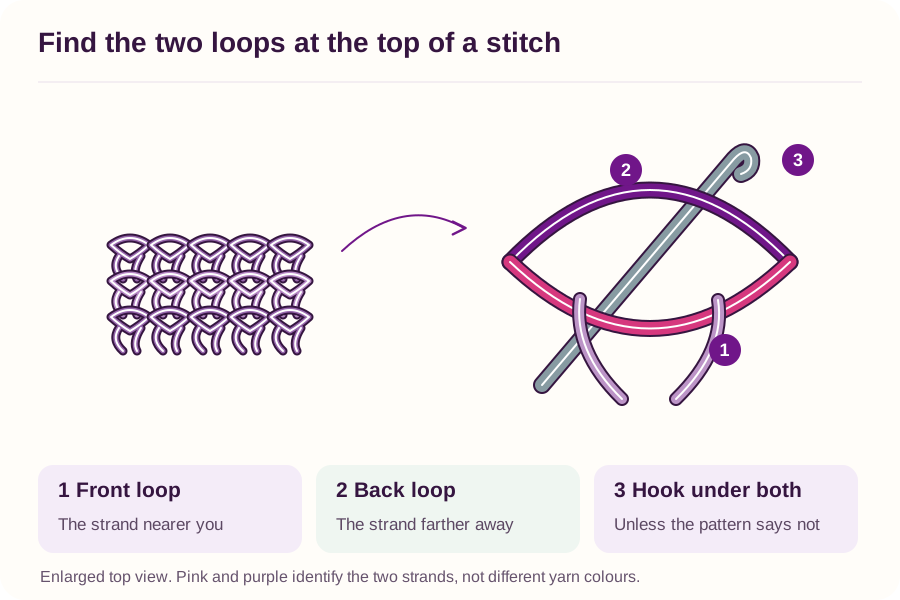
Select the diagram to open it at full size. Use the written steps for the actual hook movements.
Words you’ll meet
No need to memorise these. Keep them nearby and look up a word whenever you need it. This guide uses UK names, with US equivalents explained.
Open the plain-English word guide · 7 terms
Chain · ch
A small loop pulled through the loop on your hook. A line of chains often forms the starting edge.
UK dc / US sc
UK double crochet is called single crochet in US patterns. They are the same short stitch.
Yarn over · yo / yoh
Bring the working yarn over the hook so you can catch it and pull it through a loop.
Working yarn
The strand leading from your hook to the ball, used to make each new stitch.
Yarn tail
A loose end left at the start, finish or colour change. It needs to be secured inside the fabric.
Repeat · rep
Do the stated group of instructions again, as many times as the pattern says.
Hook shaft
The straight part of the hook behind the shaped tip. Its diameter helps set the size of the loops.
Quick note: this guide uses UK crochet names. UK double crochet is US single crochet.
Put a loop on your hook
Leave a generous yarn tail. Cross the yarn into a loop, draw a small bight of the ball-end yarn through it, then put that new loop on the hook. Gently tighten the knot underneath. The loop should still slide along the hook shaft; do not clamp it onto the narrow tip.
Make a chain — ch
- Hold the knot below the hook. Bring the working yarn over the hook from back to front: this is a yarn over.
- Catch that strand and pull it through the existing loop. One new loop stays on the hook; one chain hangs below.
- Repeat, moving your holding fingers up the growing chain so it stays steady.
Your ten-chain challenge
Count the little V shapes below the hook. Do not count the live loop or the slip knot. Make ten chains, undo them gently and try again. If pulling through is difficult, loosen your grip and keep each new loop on the full shaft before making the next one.
Sources & further learning
Checked 24 October 2026. Written in UK terms, with US equivalents where useful. Follow a project's own stitch key if it differs. These are original explanations and practice exercises, not copies of the linked publishers' patterns.