Start here · a little extra help
Find the first change, not just the last one
A mistake near the beginning of a row can make the far edge look wrong. Put the work down flat, compare the stitch count with the pattern and find the last row that looks correct. Use a marker to keep your place while investigating.
Frogging means undoing stitches so you can remake them. Remove the hook and draw the working yarn back slowly, then put the hook into the live loop at the point you want to keep. Do not cut the yarn just because one row needs correcting.
Your small practice goal
Check three things in order: the stitch count, the turning-chain rule and whether you have worked into the intended loops.
Picture it
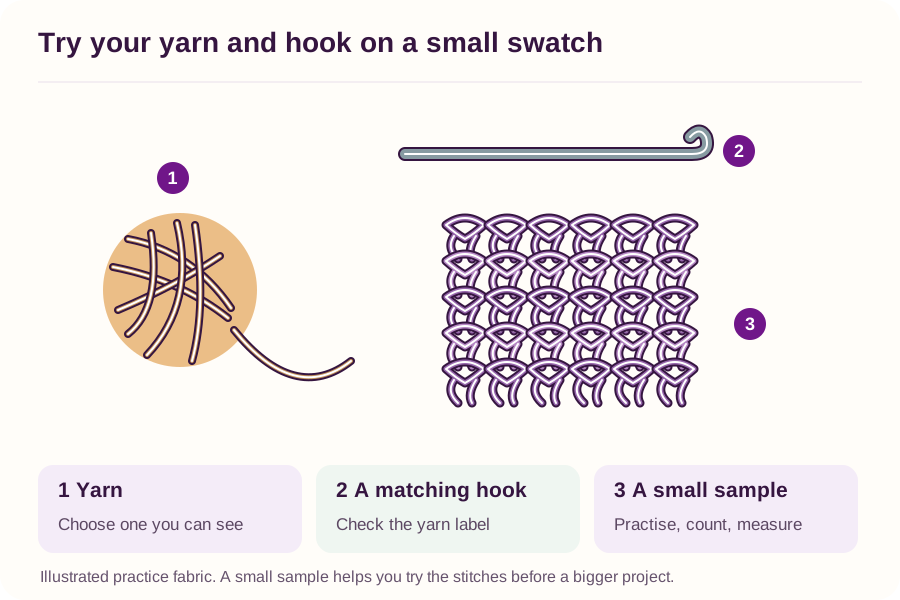
Select the diagram to open it at full size. Use the written steps for the actual hook movements.
Words you’ll meet
No need to memorise these. Keep them nearby and look up a word whenever you need it. This guide uses UK names, with US equivalents explained.
Open the plain-English word guide · 8 terms
Chain · ch
A small loop pulled through the loop on your hook. A line of chains often forms the starting edge.
UK dc / US sc
UK double crochet is called single crochet in US patterns. They are the same short stitch.
Working yarn
The strand leading from your hook to the ball, used to make each new stitch.
Yarn tail
A loose end left at the start, finish or colour change. It needs to be secured inside the fabric.
Round · rnd
A complete trip around a shape. It may be joined at the end or continue in a spiral.
Frogging
Undoing stitches so you can work them again. Usually no cutting is needed.
Hook shaft
The straight part of the hook behind the shaped tip. Its diameter helps set the size of the loops.
Stitch marker
A removable clip or scrap of contrasting yarn used to mark a stitch or place in the work.
Quick note: this guide uses UK crochet names. UK double crochet is US single crochet.
Start with the last good row
Put a marker into the live loop so it cannot run away. Count the current row and compare it with the instructions. Find the last place the stitch count and shape were right. Undo only as far as necessary, slowly, catching the live loop again.
A practical problem checker
| Problem | Check first | Try next |
|---|---|---|
| Fabric curls at the starting edge | Is the foundation tighter than later rows? | Practise a looser chain or test a larger hook just for the chain |
| Square gets narrower | Missing first or last stitch? | Use two edge markers and count each row |
| Yarn keeps splitting | Hook catching only part of a strand? | Slow down, reposition the hook and remake the affected stitch |
| Stitches are hard to enter | Loops pulled onto the narrow hook tip? | Form loops on the full shaft and relax your grip |
| Colourwork puckers | Carried strand too short? | Spread the stitches naturally before changing colour |
| Round has an extra stitch | Join or starting chain counted twice? | Mark the first real stitch and follow the pattern's count |
Save useful clues
Take a close photo, note the row number and write what you expected to happen. Those details are much more useful when asking for help than ‘it went wrong’. Put the project down for a break if your hands or patience need one.
Sources & further learning
Original Crochet By Micky practice notes. See the linked lessons for the underlying techniques.
Checked 24 October 2026. Written in UK terms, with US equivalents where useful. Follow a project's own stitch key if it differs. These are original explanations and practice exercises, not copies of the linked publishers' patterns.