Start here · a little extra help
Hide the tail inside the stitches
Weaving in means sewing the loose yarn tail through parts of the fabric so it cannot easily slide out. It is not the same as trimming the yarn close to a knot. Thread the tail into a blunt yarn needle and follow the structure of nearby stitches.
Leave enough yarn to change direction through several stitches without tightening the fabric. Different fibres grip differently, so slippery yarn may need extra care. Gently stretch and relax the sample before trimming the remaining tip, and check that the tail stays hidden.
Your small practice goal
Use a practice swatch to weave in a tail. Look at both sides and make sure you have not pulled the edge out of shape.
Picture it
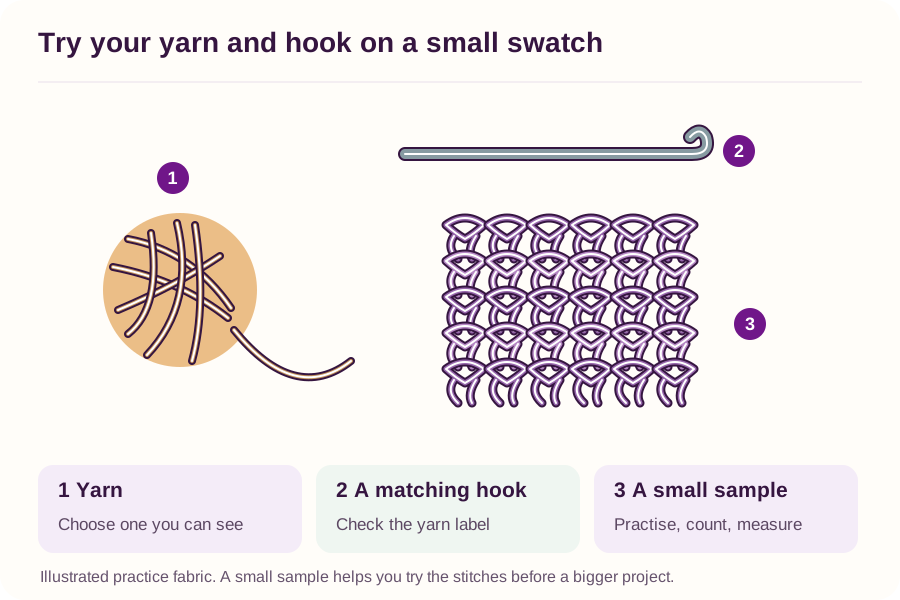
Select the diagram to open it at full size. Use the written steps for the actual hook movements.
Words you’ll meet
No need to memorise these. Keep them nearby and look up a word whenever you need it. This guide uses UK names, with US equivalents explained.
Open the plain-English word guide · 3 terms
UK dc / US sc
UK double crochet is called single crochet in US patterns. They are the same short stitch.
Yarn tail
A loose end left at the start, finish or colour change. It needs to be secured inside the fabric.
Swatch
A small sample used to practise or to check the fabric, stitch size and washing behaviour.
Quick note: this guide uses UK crochet names. UK double crochet is US single crochet.
Leave yourself enough yarn
After the final stitch, cut a generous tail and pull the cut end completely through the live loop. Do not trim it at the knot. Thread the tail onto a blunt yarn needle and work on the less visible side where possible.
Hide and secure
- Run the tail through the body of several nearby stitches, following a path that does not show on the front.
- Change direction through a neighbouring path to help resist slipping. Keep the fabric relaxed; do not gather it.
- Check both sides and gently stretch the fabric as it will be used. Trim only when you are satisfied the end is secure.
Treat awkward yarn with care
Smooth yarns and adjustable rings can need more attention than grippy wool. Do not rely on one tiny knot or glue as a universal fix. Keep a little tail until after the first appropriate wash so you can check how it settles. Weave as you go on multi-colour projects: future you will be delighted.
Sources & further learning
Checked 24 October 2026. Written in UK terms, with US equivalents where useful. Follow a project's own stitch key if it differs. These are original explanations and practice exercises, not copies of the linked publishers' patterns.