Start here · a little extra help
One row has two passes
In Tunisian crochet, the forward pass gathers loops onto the hook. The return pass works them back off. Together these make a completed row. You therefore keep more live loops on the hook than in ordinary crochet, which usually ends each stitch with one.
Use a suitable hook long enough for the sample and follow a beginner Tunisian simple-stitch tutorial. The vertical bars on the fabric are useful landmarks, but where you insert the hook depends on the stitch. Some curling is common; do not tighten harder in an attempt to stop it.
Your small practice goal
Make a very short sample and count the gathered loops before beginning the return pass. Check the final edge loop carefully.
Picture it
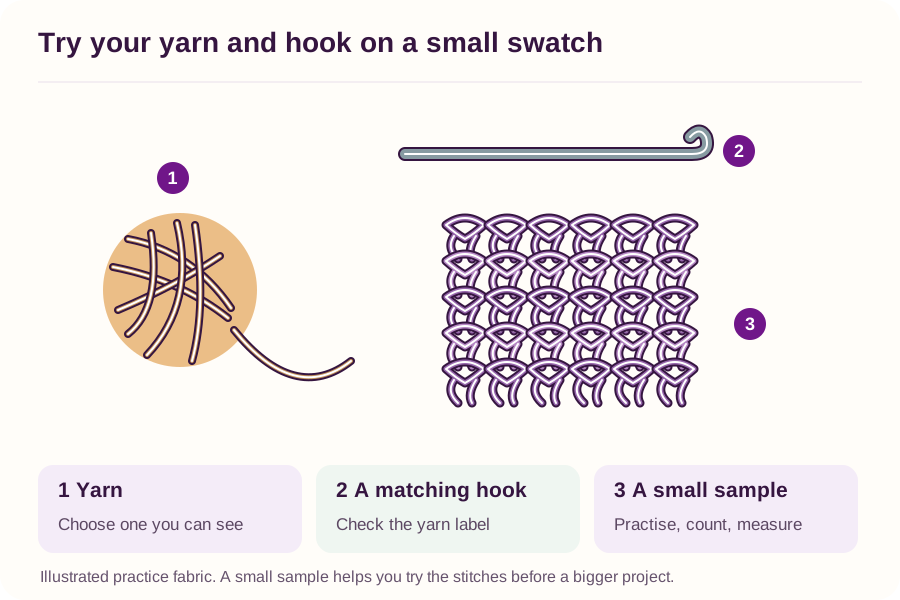
Select the diagram to open it at full size. Use the written steps for the actual hook movements.
Words you’ll meet
No need to memorise these. Keep them nearby and look up a word whenever you need it. This guide uses UK names, with US equivalents explained.
Open the plain-English word guide · 6 terms
Chain · ch
A small loop pulled through the loop on your hook. A line of chains often forms the starting edge.
UK dc / US sc
UK double crochet is called single crochet in US patterns. They are the same short stitch.
Yarn over · yo / yoh
Bring the working yarn over the hook so you can catch it and pull it through a loop.
Gauge / tension
The number of stitches and rows in a measured area. Tension can also mean how firmly you hold the yarn.
Tunisian crochet
Crochet using a forward pass to gather loops and a return pass to work them off the hook.
Repeat · rep
Do the stated group of instructions again, as many times as the pattern says.
Quick note: this guide uses UK crochet names. UK double crochet is US single crochet.
Give your loops room
Tunisian crochet keeps several live loops on the hook. A longer Tunisian hook or a compatible cable holds them safely. Start with a tiny sample, and use a hook large enough for a relaxed fabric. In ordinary flat Tunisian work, you do not turn between passes.
Try a setup row
- Ch 8. Beginning in the second chain from the hook, pull up one loop from each chain and keep every loop on the hook. Including the original loop, there are 8.
- For the return pass, yarn over and pull through one loop. Then yarn over and pull through two loops repeatedly until only one remains.
- That forward pass and return pass together make one row. Count both your picked-up loops and the vertical bars you have created.
Choose the next stitch
Tunisian simple stitch, knit stitch and purl stitch use different insertion points. Follow a dedicated stitch lesson for the next row and its edge stitch. Some curling is normal; squeezing the yarn tighter will not cure it. Keep this little sample as your starting point.
Sources & further learning
Checked 24 October 2026. Written in UK terms, with US equivalents where useful. Follow a project's own stitch key if it differs. These are original explanations and practice exercises, not copies of the linked publishers' patterns.