Start here · a little extra help
Turn shorthand into a spoken sentence
A pattern compresses repeated actions into short instructions. ‘1 dc in each of next 3 sts’ means make one UK double crochet into each of the next three stitches. You make three new stitches, not three stitches in one place.
Brackets usually group instructions; a number tells you how often to repeat that group. A total at the end of a row is often a checking number, not another instruction. Read the pattern’s own key, because designers do not all format repeats in exactly the same way.
Your small practice goal
Take one short line, write it out in ordinary words, then tick off each action as you make it.
Picture it
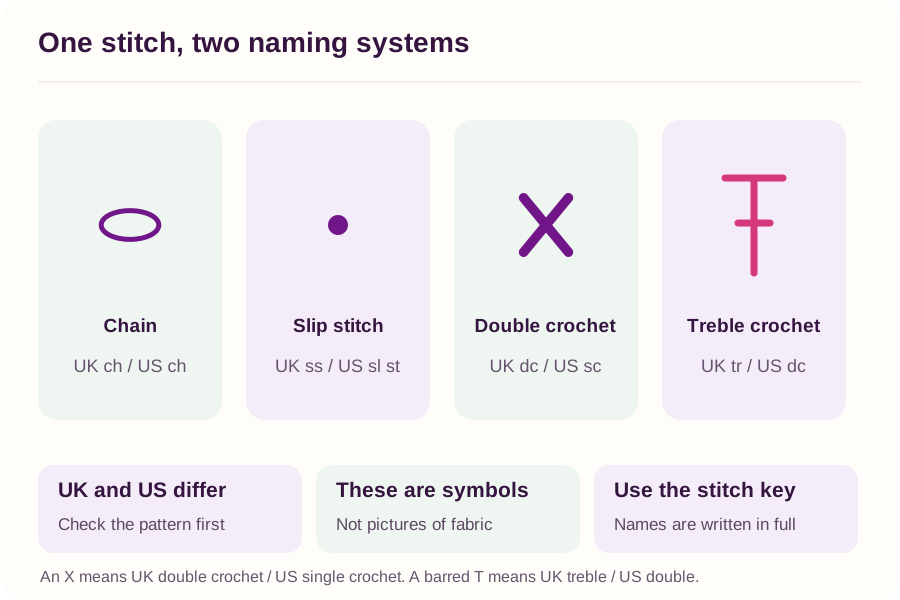
Select the diagram to open it at full size. Use the written steps for the actual hook movements.
Words you’ll meet
No need to memorise these. Keep them nearby and look up a word whenever you need it. This guide uses UK names, with US equivalents explained.
Open the plain-English word guide · 6 terms
Chain · ch
A small loop pulled through the loop on your hook. A line of chains often forms the starting edge.
UK dc / US sc
UK double crochet is called single crochet in US patterns. They are the same short stitch.
Stitch / stitches · st / sts
One finished unit of crochet, or more than one. Count the completed tops, following the turning-chain rule.
Gauge / tension
The number of stitches and rows in a measured area. Tension can also mean how firmly you hold the yarn.
Turning chain
Chains at the start of a row that reach the next stitch’s height. The pattern says whether they count as a stitch.
Repeat · rep
Do the stated group of instructions again, as many times as the pattern says.
Quick note: this guide uses UK crochet names. UK double crochet is US single crochet.
Read these bits first
Check the UK/US terminology, yarn, hook, gauge, finished size and special stitches before starting. Then look for notes about turning chains, joins and which side of the work faces you. Keep the abbreviation key nearby.
An original mini example
“(1 dc in next st, 2 dc in next st) three times. [9 sts]” uses six existing stitches. Each repeat makes three new stitches: one in the first place, two in the second. Three repeats make nine. The final bracketed number is a count, not another instruction.
Make the pattern easier to follow
- Highlight the size you are making so your eyes do not jump between sizes.
- Put a tick beside each finished row. For repeats, write a small tally beside the instruction.
- Compare your count with the pattern's count before carrying on. If they disagree, check the repeat boundaries first.
Sources & further learning
Checked 24 October 2026. Written in UK terms, with US equivalents where useful. Follow a project's own stitch key if it differs. These are original explanations and practice exercises, not copies of the linked publishers' patterns.