
Start here · a little extra help
Read the method before the chart
Mosaic crochet builds a picture using stitches worked in different places or over earlier rows. Overlay and inset are different methods, not two names for one set of instructions. Their charts may use different rules about skipped spaces, loops and how far down a stitch reaches.
A chart symbol only makes sense with its key. Do not assume an X means the same thing in every mosaic pattern, and do not substitute a general colourwork chart without converting the instructions. Practise the exact method on a small, clearly explained sample first.
Your small practice goal
Find the pattern’s method name and symbol key. Explain one ordinary square and one marked square in words before crocheting.
Picture it
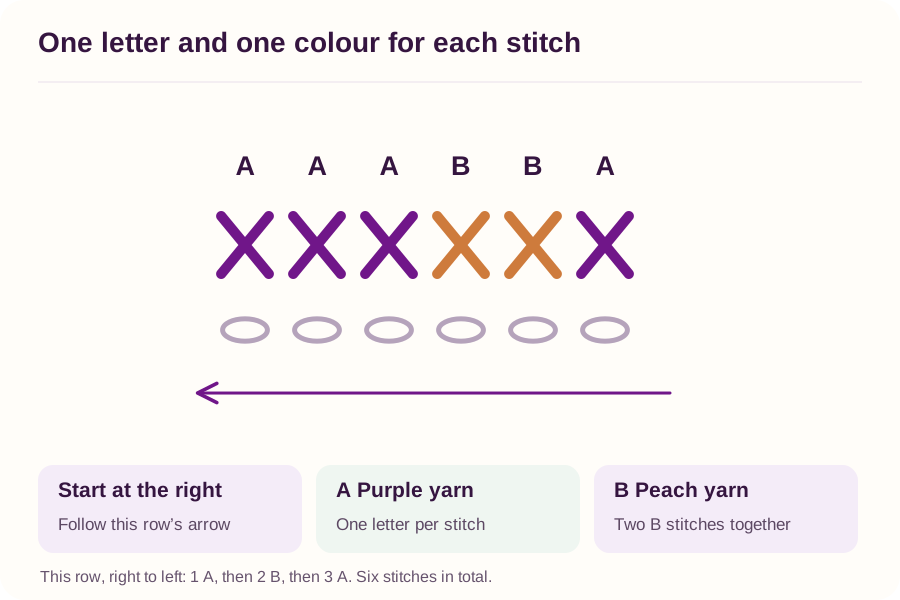
Select the diagram to open it at full size. Use the written steps for the actual hook movements.
Words you’ll meet
No need to memorise these. Keep them nearby and look up a word whenever you need it. This guide uses UK names, with US equivalents explained.
Open the plain-English word guide · 10 terms
Chain · ch
A small loop pulled through the loop on your hook. A line of chains often forms the starting edge.
UK dc / US sc
UK double crochet is called single crochet in US patterns. They are the same short stitch.
UK tr / US dc
UK treble is US double crochet. Finish by pulling through two loops, then two again.
Yarn tail
A loose end left at the start, finish or colour change. It needs to be secured inside the fabric.
Round · rnd
A complete trip around a shape. It may be joined at the end or continue in a spiral.
Chain space · ch-sp
The gap beneath chains. Working into a space means entering the gap, not splitting a strand.
BLO · back loop only
Work under only the strand of the stitch’s top V that is farther from you as you hold the work.
FLO · front loop only
Work under only the nearer strand of the stitch’s top V as you hold the work.
Repeat · rep
Do the stated group of instructions again, as many times as the pattern says.
Skip · sk
Leave the named stitch unworked and move to the next place indicated in the pattern.
Quick note: this guide uses UK crochet names. UK double crochet is US single crochet.
Inset and overlay are not interchangeable
Inset mosaic commonly uses two actual rows for each chart row, with chains leaving spaces that later stitches bridge. Overlay mosaic commonly works one right-side row at a time, alternating colours. A chart for one method cannot simply be worked using the other method's rules.
Meet overlay
A typical overlay pattern uses UK dc (US sc) in back loops and longer UK tr (US dc) into front loops two rows below. The longer stitch covers the row in between. But symbols and edge stitches vary: read that chart's own key before lifting your hook.
A sensible first attempt
- Choose a small practice pattern that names its method and provides a chart key.
- Label the background and contrast yarns, then mark the row you are following.
- Make one repeat and count before making a whole blanket width. Save every tail securely using the pattern's finishing method.
Sources & further learning
Checked 24 October 2026. Written in UK terms, with US equivalents where useful. Follow a project's own stitch key if it differs. These are original explanations and practice exercises, not copies of the linked publishers' patterns.