Start here · a little extra help
Count the tops, not the holes
A row is one pass across the work. Count each completed V along its top edge once. Gaps between stitches are not extra stitches, and the live loop on the hook is not a finished stitch. Turning chains are counted only when your pattern tells you they are.
The first and last stitch can curl towards the edge and hide. Put a removable marker into each as you make it. Move the markers up on every new row. This simple habit helps you notice an accidental increase or missed stitch immediately.
Your small practice goal
Write the stitch total after every row of a small square. If one row differs, inspect its two edges before continuing.
Picture it
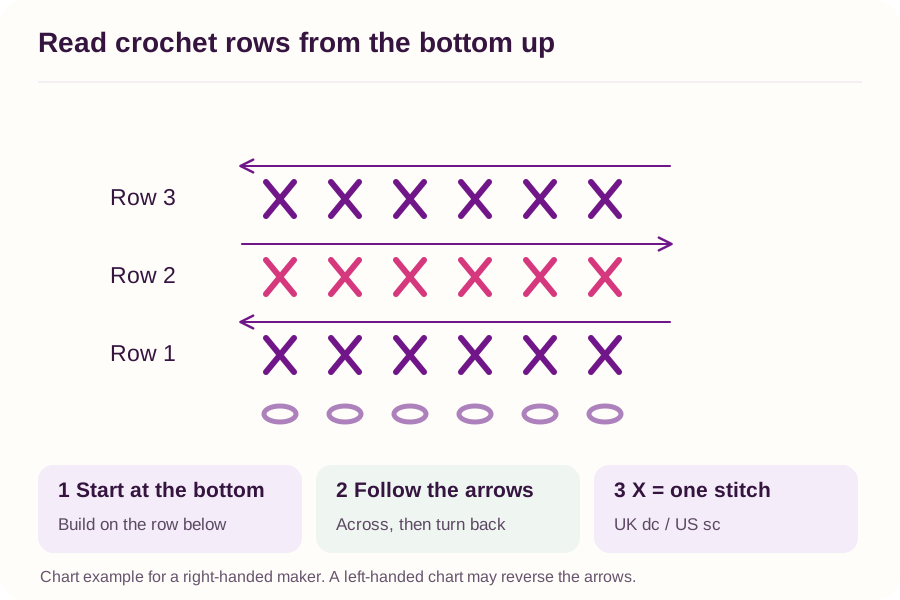
Select the diagram to open it at full size. Use the written steps for the actual hook movements.
Words you’ll meet
No need to memorise these. Keep them nearby and look up a word whenever you need it. This guide uses UK names, with US equivalents explained.
Open the plain-English word guide · 8 terms
Chain · ch
A small loop pulled through the loop on your hook. A line of chains often forms the starting edge.
UK dc / US sc
UK double crochet is called single crochet in US patterns. They are the same short stitch.
Gauge / tension
The number of stitches and rows in a measured area. Tension can also mean how firmly you hold the yarn.
Turning chain
Chains at the start of a row that reach the next stitch’s height. The pattern says whether they count as a stitch.
Increase · inc
Add stitches. A common increase makes two new stitches in one existing stitch.
Chain space · ch-sp
The gap beneath chains. Working into a space means entering the gap, not splitting a strand.
Skip · sk
Leave the named stitch unworked and move to the next place indicated in the pattern.
Stitch marker
A removable clip or scrap of contrasting yarn used to mark a stitch or place in the work.
Quick note: this guide uses UK crochet names. UK double crochet is US single crochet.
Find the stitch tops
Look down at the top edge. Each normal stitch has a little V. Count those Vs, not the bumps on the side. The live loop on your hook is not an extra stitch. Whether a turning chain counts depends on the instructions.
The two-marker habit
- Place a marker in the first real stitch of the row, or the top of the turning chain if it counts.
- Mark the last stitch too. Move both markers as each new row is made.
- Pause and count at the end of every row. Fix a missing stitch now instead of ten rows later.
A quick diagnosis
| What you see | What to check |
|---|---|
| Edges lean inward | Did you miss the last marked stitch? |
| Edges grow outward | Did you work into a turning-chain base that already counts? |
| Count is right, edge is wavy | Are your tension and turning-chain size changing? |
| One huge hole | Did you skip a stitch or insert into a space? |
Sources & further learning
Original Crochet By Micky practice notes. See the linked lessons for the underlying techniques.
Checked 24 October 2026. Written in UK terms, with US equivalents where useful. Follow a project's own stitch key if it differs. These are original explanations and practice exercises, not copies of the linked publishers' patterns.