Start here · a little extra help
A useful way to read craft history
A dated pattern book, museum object or newspaper can show that a technique existed by a particular time. That does not automatically tell us who invented it. Earlier looped textiles may use different methods even when they look similar in a photograph.
When you read a historical claim, ask what evidence supports it and whether the writer is discussing crochet, knitting, lace or another technique. A museum catalogue often explains materials, place and approximate date; an approximate date is an estimate, not an exact birthday.
Your small practice goal
Open one museum source from this guide. Find the object’s date and materials, then write one thing it proves and one thing it does not.
Picture it
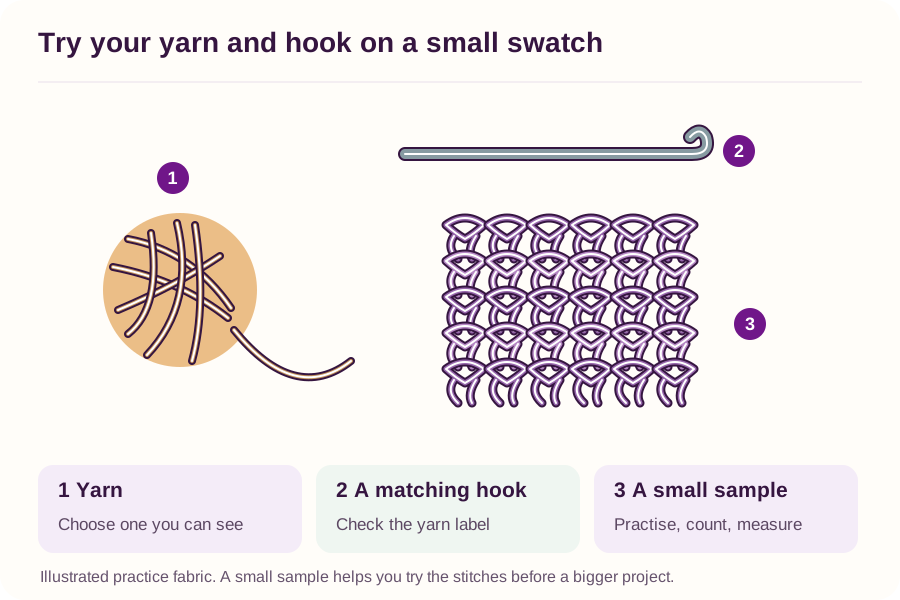
Select the diagram to open it at full size. Use the written steps for the actual hook movements.
Words you’ll meet
No need to memorise these. Keep them nearby and look up a word whenever you need it. This guide uses UK names, with US equivalents explained.
Open the plain-English word guide · 4 terms
UK dc / US sc
UK double crochet is called single crochet in US patterns. They are the same short stitch.
Yarn tail
A loose end left at the start, finish or colour change. It needs to be secured inside the fabric.
Repeat · rep
Do the stated group of instructions again, as many times as the pattern says.
Stitch post
The upright body of a stitch below its top V. A post stitch works around that body rather than into the top loops.
Quick note: this guide uses UK crochet names. UK double crochet is US single crochet.
A name with a hook in it
The word crochet comes from French for a small hook. Its earliest origins are less certain than many neat internet timelines suggest. There are possible connections with older hooked and embroidered techniques, but a possible connection is not a proven invention story.
The nineteenth-century paper trail
The Textile Research Centre describes crochet's growing visibility in the early nineteenth century and points to the Dutch magazine Pénélopé in 1824. Printed instructions helped techniques travel. Later crochet lace and everyday household work show how the same tool could create both practical fabric and astonishing detail.
A royal maker — and ordinary makers too
London Museum has written about a crochet blanket made by Queen Victoria in 1883. That is a memorable object, but crochet history is also full of less famous makers teaching family, earning money, adapting patterns and passing skills along.
Be a history detective
When a post claims crochet is ‘thousands of years old’, ask what surviving object or dated document supports the claim. Look for museum records rather than repeating a lovely-sounding story as fact. You can enjoy the mystery without pretending it has been solved.
Sources & further learning
Checked 24 October 2026. Written in UK terms, with US equivalents where useful. Follow a project's own stitch key if it differs. These are original explanations and practice exercises, not copies of the linked publishers' patterns.