Start here · a little extra help
Think in diagonal tiles
C2C is short for corner-to-corner. In the common block method, groups of chains and tall stitches form little tiles that grow along a diagonal. A square on that kind of chart represents a whole tile, not one UK double crochet stitch.
You increase at the edges to make diagonal rows longer, then decrease when the intended width or height is reached. The block recipe and turning instructions depend on the pattern. Micky’s image-to-chart tool currently uses individual UK-dc cells, so it is not a ready-made C2C instruction generator.
Your small practice goal
Draw three diagonal rows of tiles on paper. Count tiles separately from the stitches that make each tile.
Picture it
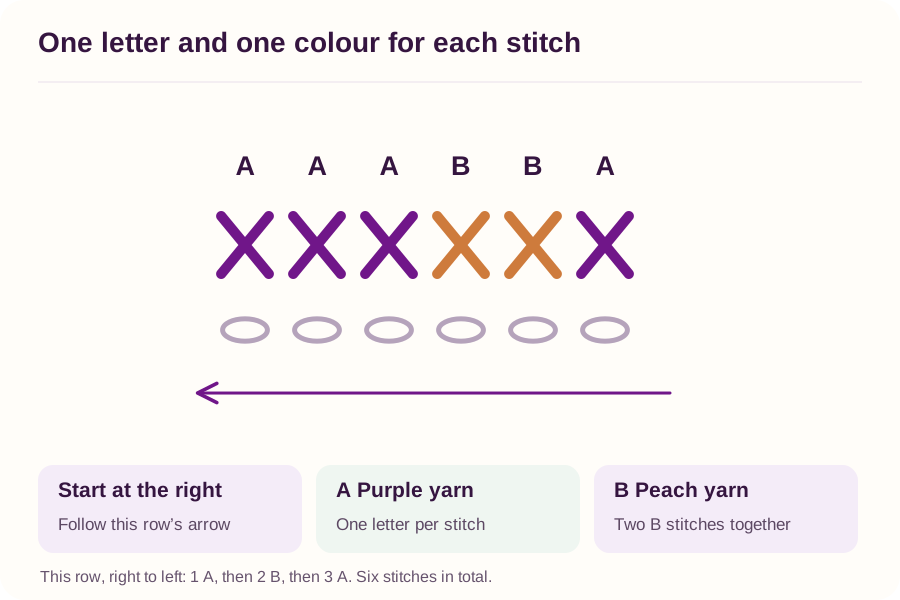
Select the diagram to open it at full size. Use the written steps for the actual hook movements.
Words you’ll meet
No need to memorise these. Keep them nearby and look up a word whenever you need it. This guide uses UK names, with US equivalents explained.
Open the plain-English word guide · 9 terms
Chain · ch
A small loop pulled through the loop on your hook. A line of chains often forms the starting edge.
UK dc / US sc
UK double crochet is called single crochet in US patterns. They are the same short stitch.
UK tr / US dc
UK treble is US double crochet. Finish by pulling through two loops, then two again.
Slip stitch · sl st
A low connecting stitch: pull the new yarn through the insertion point and the loop on the hook.
Increase · inc
Add stitches. A common increase makes two new stitches in one existing stitch.
Decrease · dec / 2tog
Reduce the count. ‘2tog’ means two together: two existing stitches are joined into one finished top.
Chain space · ch-sp
The gap beneath chains. Working into a space means entering the gap, not splitting a strand.
C2C · corner-to-corner
A method worked diagonally. In common block C2C, each chart square is a tile of several stitches.
Skip · sk
Leave the named stitch unworked and move to the next place indicated in the pattern.
Quick note: this guide uses UK crochet names. UK double crochet is US single crochet.
Think tiles, not single stitches
Classic C2C grows diagonally using blocks of UK treble stitches (US double crochet). A chart square represents a tile, not one ordinary dc. You increase at the edges to grow the piece and decrease to finish it; a rectangle has an increase edge and a decrease edge for part of the project.
Make two diagonal rows
- Ch 6. Work a UK tr into the fourth chain from the hook, then each of the next two chains. The skipped chains and three trebles form the first tile.
- For the next row, ch 6 and make another tile in the same way. Turn the first tile so its ch-3 space is beside your hook.
- Slip stitch into that ch-3 space. Ch 3 and work 3 tr into the same space. You now have two tiles in the second diagonal row.
Before turning it into a picture
Practise a small square using a full C2C increase-and-decrease tutorial. Measure a tile to estimate size. Micky's Pattern Maker produces a flat UK-dc/US-sc chart, not ready-written C2C instructions: its row directions and dimensions must not be treated as C2C directions.
Sources & further learning
Checked 24 October 2026. Written in UK terms, with US equivalents where useful. Follow a project's own stitch key if it differs. These are original explanations and practice exercises, not copies of the linked publishers' patterns.